Start with the outcome: a hybrid AI live chat that safely performs first‑line eligibility checks (benefits, housing, council services), reduces manual workload, and preserves legally admissible audit trails — while keeping data in the UK.

Why eligibility decisions need a different approach
Eligibility checks sit at the intersection of automated convenience and regulatory risk. A wrong answer can delay an urgent housing allocation, misdirect a benefits claim, or trigger a formal complaint under FOI or DPA rules.
- These interactions are high‑intent: the user is often time‑sensitive and vulnerable.
- They require explanations, evidence trails, and human judgement for edge cases.
- They must comply with UK data‑protection expectations and public‑sector transparency.
The Information Commissioner’s Office has been explicit about expectations for AI governance, explaining decisions, and clear accountability — recent ICO strategy updates make governance non‑negotiable for public services. (ico.org.uk)
Three technologies that look the same but behave very differently
Before building a solution, be precise about the engine you choose.
- Rule‑based chatbots: deterministic scripts and decision trees. Good for simple form capture and signposting, but brittle for ambiguous eligibility questions.
- Pure LLM bots: general large language models that generate fluent replies from patterns. Fast, but they can hallucinate and lack a traceable knowledge source — risky for regulated advice.
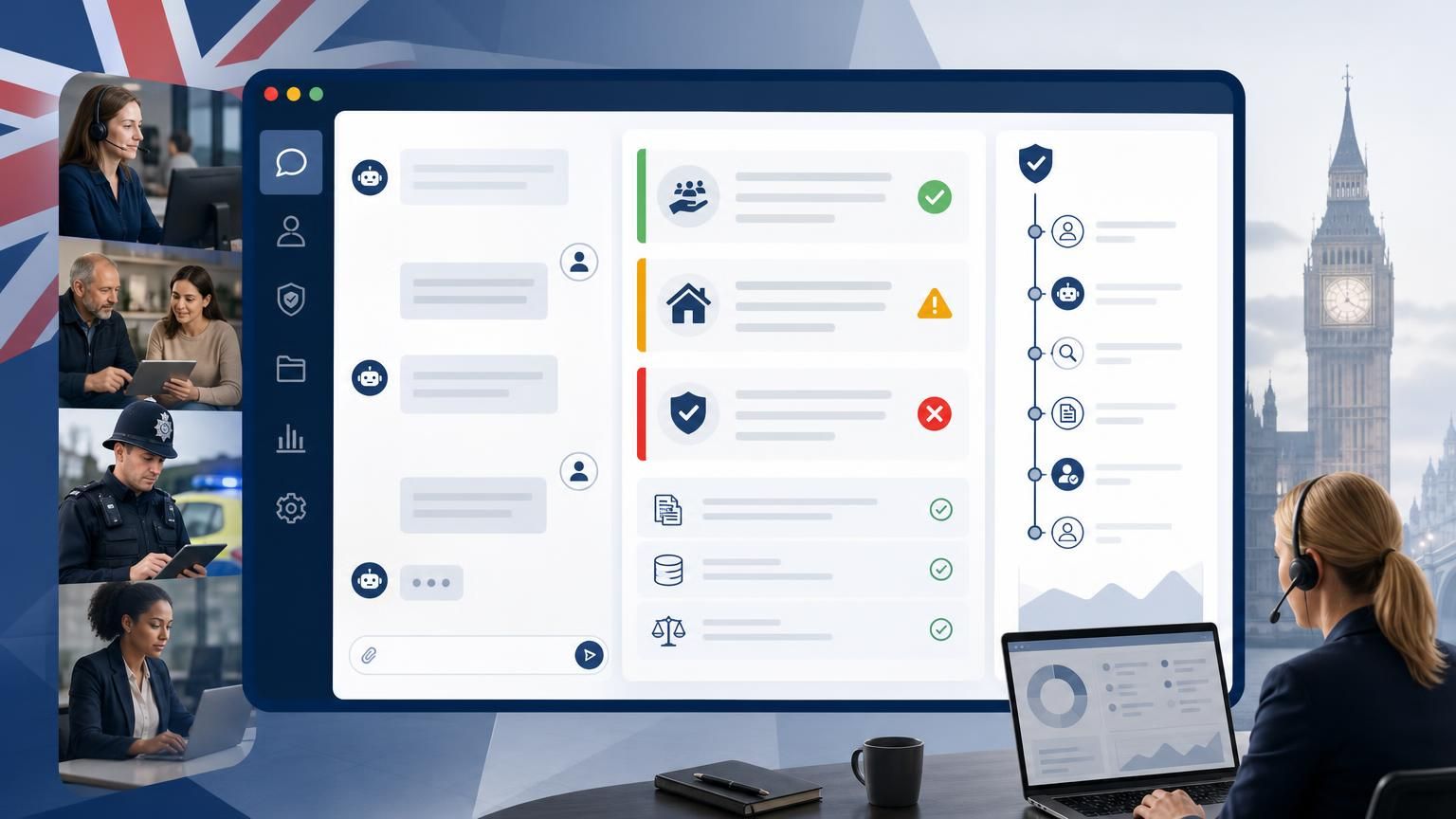
- Hybrid AI live chat: RAG (retrieval‑augmented generation) + workflow logic + human handoff. The AI answers are grounded in your documents, and workflows enforce routing, consent capture and audit logs. This is the pattern councils and regulated teams should favour. (imsupporting.com)
How a practical, low‑risk eligibility flow is architected
Design around three immutable principles: ground, explain, and escalate.
- Ground (RAG knowledge):
- Ingest local policy documents, guidance notes, decision trees and past case summaries into a private knowledge store.
- The AI retrieves exact passages to compose answers, reducing hallucination and ensuring traceability. This is retrieval‑augmented generation in action. (imsupporting.com)
- Explain (explainability & consent):
- Present the user with the source lines or a short reference and an offer to view more (e.g. ‘This answer is based on section 4.2 of the Housing Allocations Policy’).
- Log the exact retrieval and model output for every response — not optional metadata, but primary case evidence.
- Escalate (human-in-the-loop & workflows):
- Use a visual hybrid workflow to route edge cases automatically to the right team (housing officer, benefits assessor, safeguarding lead). Automation handles straightforward checks; humans handle judgement calls. (imsupporting.com)
A short operational checklist for councils, police estates and housing associations
- Start with a limited scope: choose three high‑volume, low‑risk eligibility scenarios (e.g. council tax reduction pre‑checks, emergency temporary housing triage, or benefits document checklists).
- Build a RAG knowledge pack: canonical policies, FAQs, form templates and previous anonymised decisions.
- Set hard guardrails in the workflow: max AI confidence thresholds, mandatory consent capture, and automatic human escalation for any flagged words (vulnerability, safeguarding, legal challenge).
- Ensure UK hosting and data residency to reduce international transfer complexity — and reflect this in your DPIA. 8% of UK organisations reported using AI decision tools in 2024, so expect closer regulatory interest and audit. (ico.org.uk)
Risk controls that matter (practical, not theoretical)
- Audit logs as primary evidence: store retrieved text, vector IDs, user query, timestamp, agent handover notes and final disposition.
- Versioning and retention: keep the snapshot of the knowledge source that produced the answer. If policy changed, the log shows which policy was used.
- Role‑based access: only designated staff can retrain or refresh knowledge bases; maintain separate test and production RAG indexes.
- Cyber hygiene: treat the AI stack like any other system — threat modelling, pen tests and a supply‑chain review of any external model providers. The UK Government’s AI cyber security code of practice sets clear expectations on securing AI systems. (gov.uk)
Legal and copyright pragmatics for RAG-based systems
RAG systems that ingest documents need a pragmatic legal view. If you copy external copyrighted documents into your UK corpus for processing, UK copyright rules apply and should inform procurement and retention policies. Plan for this during any large‑scale ingestion. (gov.uk)
A short proof‑of‑value project (8–10 weeks)
Week 1–2: Choose use case, gather canonical documents, run DPIA scoping.
Week 3–4: Build RAG knowledge set, configure workflow branches and consent flows.
Week 5–6: Pilot with staff‑only traffic, measure accuracy, refine content and escalation thresholds.
Week 7–8: Soft launch to the public with explicit consent banners and a human‑first fallback. Measure time‑to‑triage, escalation rate and complaint rate.
Expected measurable outcomes:
- Reduced average triage time by 30–60% for routine checks.
- Human escalations limited to genuine edge cases, improving agent productivity.
- Clear audit trails that shorten complaint investigations and FOI case handling time.
How to evaluate vendors and tech partners
Ask each supplier for:
- Evidence of UK hosting and data residency commitments.
- A clear description of how RAG retrievals are stored and versioned.
- Workflow screenshots showing conditional routing and mandatory human handoffs for vulnerable flags.
- A transparent incident and model‑change log.
IMSupporting provides RAG grounding and a visual hybrid workflow builder designed for these use cases — from document ingestion to conditional handoffs. Review their RAG explanation and workflow features as a starting point for procurement briefs. (imsupporting.com)
Final checklist before going live (non‑negotiable)
- DPIA and risk register signed off by your SIRO.
- Explicit user consent text visible in chat and recorded per session.
- Hands‑on training for frontline staff on reading RAG citations and reversing AI suggestions.
- A rollback plan and a rapid human‑only mode should anything go wrong.
Next step — a low‑risk way to begin
If your organisation needs a UK‑hosted, GDPR‑ready hybrid AI chat that supports RAG grounding, visual workflows and auditable handoffs, review a platform built with those features in mind and trial a focused eligibility pilot. See how IMSupporting packages RAG knowledge and hybrid workflows for UK customers and public services. (imsupporting.com)
Start a pilot today and keep data in the UK: https://imsupporting.com/
CTA: Book a short discovery demo with IMSupporting to scope a secure, auditable eligibility pilot for your council, housing association or regulated team.