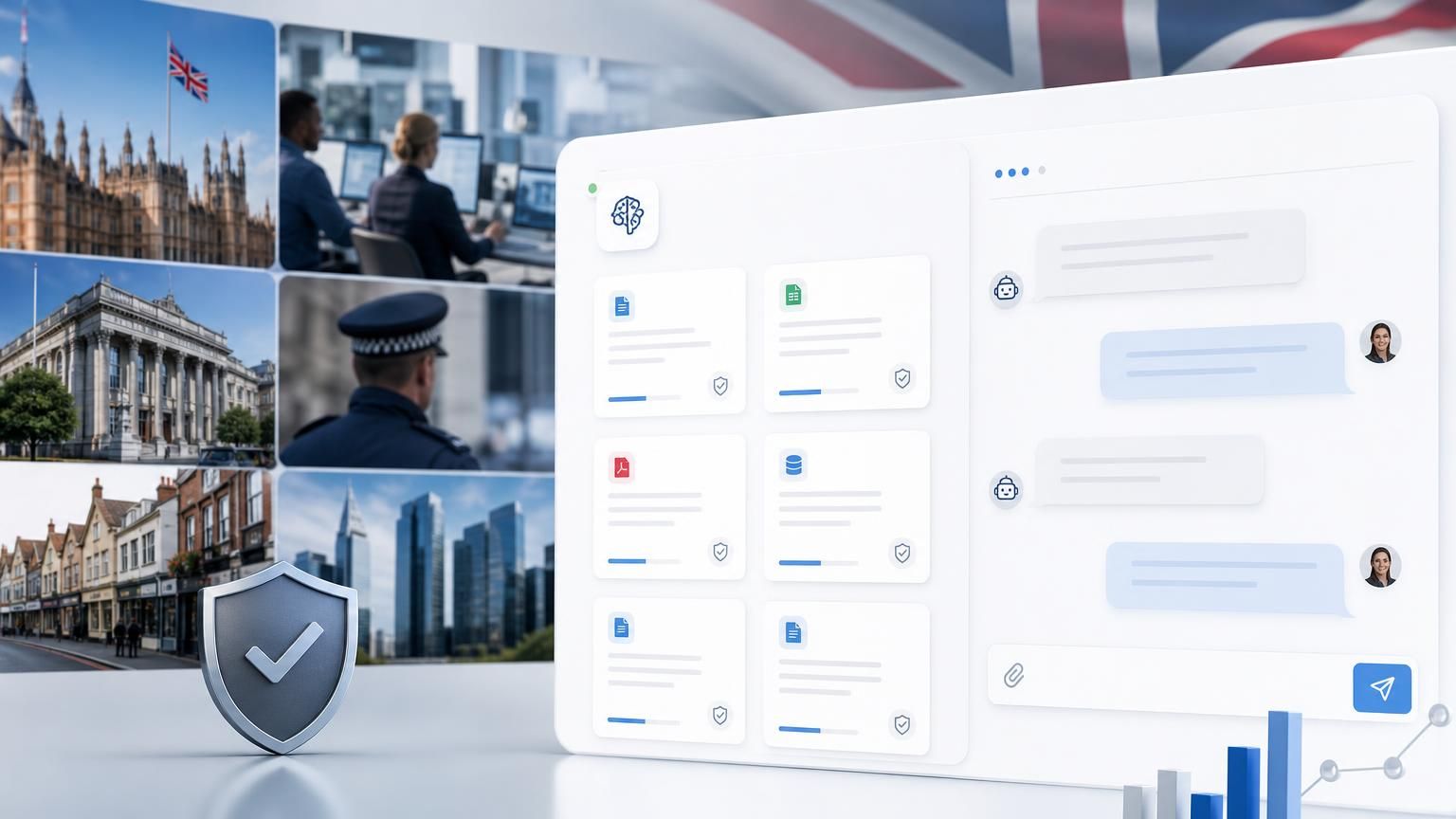
Why UK-hosted hybrid AI live chat is now table stakes
Live chat is no longer just a conversion channel — it’s the frontline triage engine for high‑risk, regulated support. UK public sector teams, police, councils and housing associations must balance speed with legal oversight and data sovereignty. The right hybrid approach delivers both: instant answers for routine problems and human expertise for anything that matters.
The simple taxonomy every procurement lead should use
- Rule-based chatbots: scripted trees and keyword flows. Predictable, cheap, but brittle in unstructured queries. Best for simple, button-driven tasks (forms, opening times).
- Pure LLM bots: large language models produce fluent responses from prompts and broad knowledge, but without careful grounding they can hallucinate and risk exposing sensitive data or making unauditable decisions.
- Hybrid AI live chat: AI triage + RAG grounding + human handoff. AI handles classification, fast answers from a versioned knowledge base, and hands off with context and audit trail when complexity or regulation demands it.
Contrast: hybrid AI doesn’t mean fully automated decisions — it means automation where safe, and clear human-in-the-loop escalation where law, policy, or trust require it.
Market and regulatory reality (what your board will ask)
National guidance and public sector policy explicitly expect clarity about automated tools and clear handoffs to people; GOV.UK guidance says webchat should complement human channels and be transparent about limitations. (gov.uk) The ICO’s Guidance on AI and Data Protection requires transparency, DPIA thinking and fairness considerations when AI touches personal data — a non‑negotiable for councils, police and housing teams. (ico.org.uk) Analyst research also makes the commercial case: analysts recommend a hybrid approach — AI plus humans — as the practical strategy for quality CX at scale. ()
How hybrid AI live chat changes support operations (the playbook)
- Start with triage, not replacement
- Use hybrid AI to classify intent, extract key metadata (service type, urgency, vulnerability flags) and surface relevant, versioned knowledge to the agent console.
- If confidence is high for a routine query, resolve automatically but record the transcript and knowledge source.
- RAG-grounded answers for auditability
- Always return model responses with a traceable source: which document, paragraph or policy statement supplied the answer. That’s RAG (Retrieval-Augmented Generation) grounding and it is the linchpin of safe deployments. It gives compliance teams a direct link from chat output to the underlying policy. See a practical implementation example. https://imsupporting.com/feature-rag-based-ai-agent-knowledge.php
- Seamless, contextual human handoff
- When a case is flagged (vulnerability, regulatory decision, financial transaction), the AI should hand off with a short summary, confidence score and links to the sources the AI used. Handoffs must preserve the transcript and agent notes to avoid repeated questioning and to protect vulnerable users.
- Instrumentation and audit trails
- Log ingress/egress events, RAG citations, DPIA triggers and agent overrides. These logs are necessary for FOI reviews, tribunals and internal audit.
Practical configuration checklist for procurement teams
- Hosting: insist on UK‑hosted data centres (in‑country data residency for chat transcripts and logs).
- RAG support: confirm the product supports document-level retrieval and citation, not just prompt‑level context. https://imsupporting.com/feature-rag-based-ai-agent-knowledge.php
- Workflow builder: low‑code flow editor that lets you model consent, escalation, and multi‑party approvals. Look for hybrid AI workflow templates you can adapt. https://imsupporting.com/feature-hybrid-ai-chat-workflows.php
- Explainability: can the system show why a decision was suggested? This matters under ICO transparency expectations. (ico.org.uk)
- Human override: agents must be able to correct, add evidence and mark the final disposition without losing provenance.
Measurable KPIs that matter to regulated services
- Triage accuracy: % of chats correctly classified to department or workflow.
- Escalation reduction: % fewer contacts needing specialist intervention after AI triage.
- Time to first meaningful reply: reduce initial wait for routine issues to under 3 minutes — consumers now expect near‑real‑time responses. Recent CX studies show 82% of consumers expect a response within three minutes for online chat. ()
- Audit completeness: % of resolved cases with RAG citations and agent sign‑off.
- Outcome quality: first‑contact resolution and downstream complaints (measure rollback rates).
Design patterns that keep risk low and adoption high
- Consent-first banner: tell users when AI is answering and give a one‑click route to a human. GOV.UK guidance recommends clear signposting when automation is used. (gov.uk)
- Confidence thresholds: only allow automatic closures above a confidence + evidence threshold; everything else is escalated.
- Progressive disclosure of data: only reveal personally identifying fields to the AI when strictly necessary and logged.
- Role-based views: agents, safeguarding officers, auditors and IT need different dashboards and filtered access to logs.
Competitive reality — why hybrid wins commercially
Vendor hype sells ‘fully autonomous’ bots; reality shows customers want humans for high‑stakes interactions and faster answers for routine ones. Analyst and industry benchmarks underline this: hybrid orchestration (AI triage + human resolution) is the operational sweet spot for speed, quality and compliance. () Practical pilots show measurable uplift: organisations that combine smart triage with RAG grounding reduce specialist referrals and recontacts — cutting cost per contact while preserving compliance and trust. Real experiments have recorded uplifts in conversion and resolution for real‑time support when AI handled routine triage and agents handled exceptions. ()
Quick implementation roadmap for councils, housing associations and police teams
- Week 0–4: discovery — map top 20 intents, source policy documents and identify legal decision points.
- Week 5–8: build knowledge corpus, enable RAG indexing and configure confidence thresholds.
- Week 9–12: pilot on low‑risk services (opening times, forms) with full logging and opt‑in AI responses.
- Month 4–6: extend to medium‑risk workflows, enable agent handoff templates and audit exports.
- Ongoing: monthly review of DPIA, bias checks and knowledge refresh cadence.
Final checklist before procurement sign‑off
- UK hosting and data residency confirmed.
- RAG citations and exportable audit logs available by default.
- Low‑code hybrid workflow templates to model consent and escalation. https://imsupporting.com/feature-hybrid-ai-chat-workflows.php
- Compliance review against ICO guidance and local procurement rules. (ico.org.uk)
If you need a practical UK‑hosted platform with RAG grounding, hybrid workflow templates and audit trails built for regulated teams, explore IMSupporting’s feature set and compliant deployment options at https://imsupporting.com/. For an immediate demo and technical walk‑through focused on councils, housing associations and police teams, contact their team via the site and ask for the UK public‑sector playbook.
Strong CTA
Book a demo with a UK‑hosted vendor that supports RAG grounding and hybrid chat workflows today: https://imsupporting.com/ — request the public‑sector playbook and ask for an evidence pack showing RAG citations and audit exports in live transcripts.