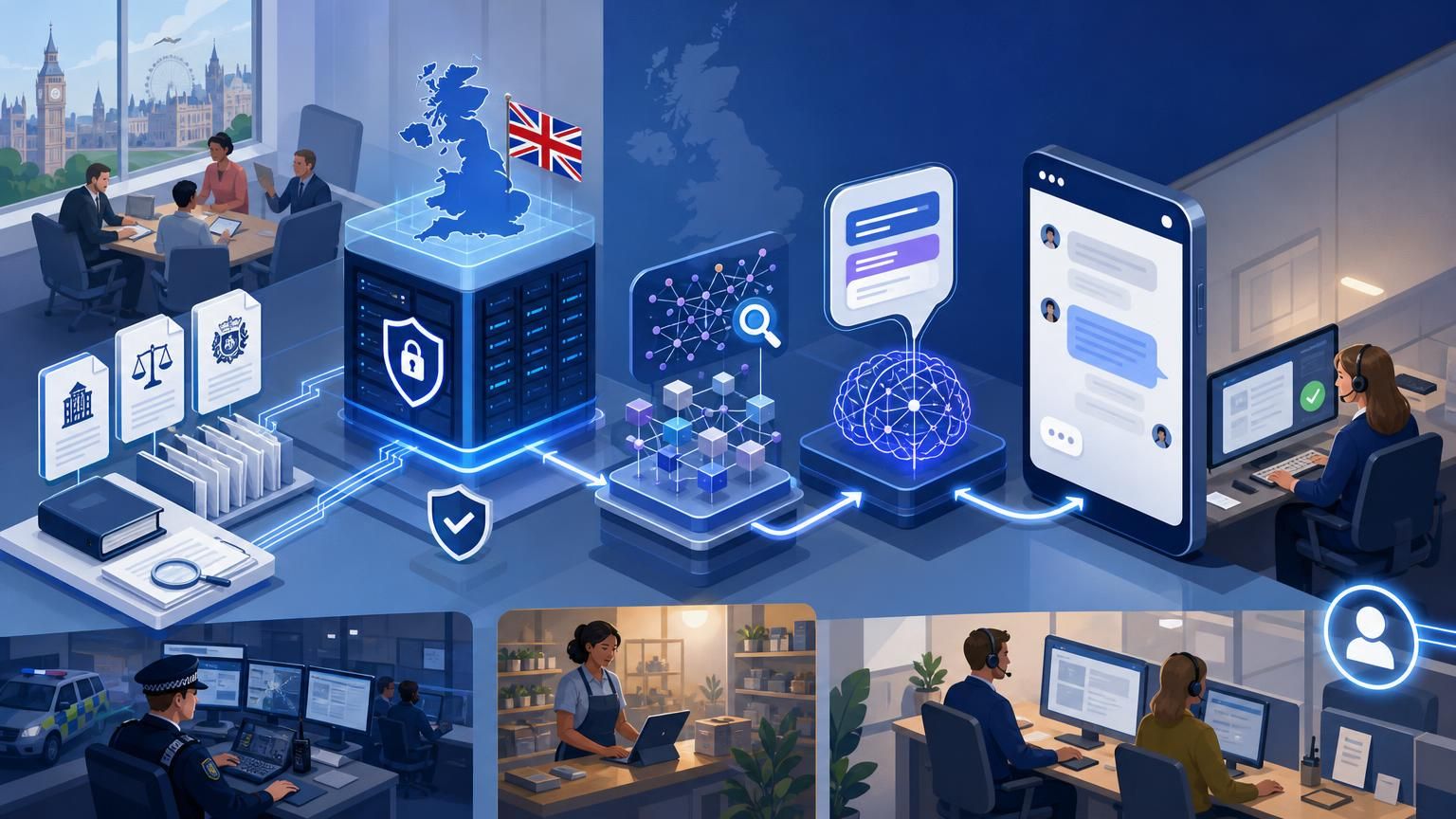
Why UK-hosted hybrid AI matters now
UK public services and regulated organisations face three simultaneous pressures: tighter budgets, higher public expectations for 24/7 access, and stricter data sovereignty needs. Deploying a UK-hosted hybrid AI live chat gives you a route that addresses all three: keep sensitive data inside the UK while offering instant, contextual help—and a clear human escalation path for edge cases.

Hybrid approaches are not theoretical. Retrieval‑Augmented Generation (RAG) and hybrid routing have matured into production patterns that combine searchable, auditable knowledge with large language models to generate grounded answers from your documents and policy libraries. ()
The commercial payoff in plain numbers
If you run services where conversion, triage speed and compliance matter, live chat is a high-leverage channel. Visitors who engage with live chat are about three times more likely to convert; proactive chat invitations typically lift conversion 10–15% and chat users spend ~20% more per transaction—figures that hold across service and commerce sites. These are the kinds of uplifts that change whether a digital service pays for itself within months. ()
Three distinct systems—know which one you have
Rule-based chatbots
- Deterministic: pre-written decision trees, scripted responses, form-driven flows. Good for straightforward FAQs and policy-driven pathways (e.g., report a missed bin collection). Low ML risk, easy to audit, but brittle with ambiguous queries.
Pure LLM bots
- Generative-first: answers come from an LLM trained on wide internet corpora and prompt templates. They are flexible and natural-sounding, but can hallucinate, lack traceability, and raise clear data sovereignty concerns if models run off-shore or rely on third‑party APIs without grounding.
Hybrid AI live chat (the practical sweet spot)
- Combination model: rule-based flows cover high-confidence tasks and compliance checkpoints; a RAG-enabled LLM provides grounded, up-to-date answers pulled from your document store; human agents receive intelligent triage and handoff when the system detects risk, uncertainty or emotional complexity.
- This hybrid pattern reduces agent load, maintains audit trails, and keeps the most sensitive processing under local control.
Hybrid architectures that use RAG to ground model outputs and rule layers for policy enforcement are now supported by proven patterns and provider guidance. They are specifically useful where auditable evidence and UK data residency are required. ()
Practical roadmap for UK councils, police and regulated teams
Follow a phased rollout—short sprints; measurable outcomes.
- Discovery (2–4 weeks) — map your high-volume support intents, SLAs and data classes. Identify the documents and datasets you'd allow the RAG index to use.
- Sandbox RAG + rule-based flows (4–6 weeks) — build a small RAG index from policy PDFs, process guides and local pages; run the LLM in a read-only, UK-hosted environment and add rule gates for consent, finance, and safeguarding interactions.
- Agent augmentation + handoff (4 weeks) — add hybrid workflows so AI triages and drafts replies while agents edit and approve; measure time-to-first-answer and escalation rates.
- Compliance review & DPIA (ongoing) — capture logs, ground responses to doc IDs, and add versioned evidence outputs for audits.
Councils that used targeted AI to accelerate channel shift reported reductions in live form and phone volumes—allowing faster responses for emergencies and complex cases while keeping routine work automated and auditable. ()
Operational guardrails you must enforce
- UK hosting and data residency: run indexes and inference inside UK-controlled infrastructure.
- RAG explainability: store the document IDs and retrieved snippets used to generate each answer so every response has an evidence trail.
- Rule-based safety gates: force handoff on topics flagged by severity, finance, safeguarding, legal requests or where confidence falls below a set threshold.
- Continuous human-in-the-loop review: sample and score AI replies, then feed corrections back into your knowledge base and RAG index.
These guardrails are not optional in regulated contexts; they convert AI from a compliance hazard into a governance advantage.
Quick ROI playbook (what to measure)
- Response time: aim to cut average time-to-first-answer by 50% in targeted services.
- Escalation rate: a healthy early rollout reduces low‑value escalations by 30–60% as AI handles routine Qs and agents focus on exceptions.
- Cost per contact: automated triage + scripted self‑service can cut average handling costs materially—fast payback for high‑volume teams.
- Conversion/transaction uplift for service sign-ups or payments: track conversion among users who engaged with chat versus the control cohort. The channel often delivers the strongest per-session conversion uplift of any entry point. ()
How IMSupporting maps to this approach
IMSupporting is built for the exact hybrid pattern described here: UK-first hosting, RAG-enabled knowledge modules and workflow-level hybrid AI handoffs. Use the RAG knowledge feature to ground replies in your local policies and statutory guidance, and the hybrid AI workflows to automate triage while keeping agents in control. See the RAG feature overview and hybrid workflows for technical detail and procurement-ready capabilities: https://imsupporting.com/feature-rag-based-ai-agent-knowledge.php and https://imsupporting.com/feature-hybrid-ai-chat-workflows.php.
IMSupporting’s approach is pragmatic: you retain audit logs, store retrieved evidence with every AI response, and set escalation rules that meet public sector DPIA and records requirements. That makes it a strong fit for councils, police contact centres, housing associations and regulated teams that can’t compromise on traceability.
Implementation checklist (30/60/90 day milestones)
- 30 days: selected pilot service, RAG index built from top 20 documents, rule gates for risk topics.
- 60 days: integrate agent workspace and real-time handoff; set escalation thresholds and consent prompts.
- 90 days: run a compliance review, measure KPIs, expand to three more services and prepare procurement pack/DPIA evidence.
Final take: choose pragmatic hybrid, not theoretical perfect
Rule-based bots are safe but limited. Pure LLM bots are flexible but risky for regulated UK services. Hybrid AI live chat that uses RAG grounding, UK-hosted inference, and explicit human handoff delivers the best of both worlds: speed, measurable uplift, and auditability.
If you’re responsible for support in a council, police force, housing association or regulated SME, start with a narrow pilot that keeps everything UK-resident and documented. For practical help getting from pilot to procurement‑ready rollout, review IMSupporting’s platform and feature set and arrange a demo at https://imsupporting.com/.
Ready to brief procurement? Start with the RAG docs and hybrid workflows to craft your DPIA and SLA requirements: https://imsupporting.com/feature-rag-based-ai-agent-knowledge.php and https://imsupporting.com/feature-hybrid-ai-chat-workflows.php.
Strong CTA — Book a demo and procurement pack Pilot a UK-hosted hybrid AI live chat that keeps data in-country and hands off to human experts when it matters. Book an initial demo and download a procurement-ready feature brief at https://imsupporting.com/.